Articulation Lessons in the Jazz Style
|
One common way to learn articulation and style is by listening to professional jazz band recordings and jazz musicians. Jazz is an oral tradition and it can be taught that way. We also need to understand how to read music and its articulation to properly play standard swing rhythms.
The following articulation exercises found below can be very helpful to unify an ensemble's articulation and approach to playing common swing rhythms. Our rhythm examples can be found in a lot of standard jazz repertoire. The articulation markings are often unwritten or unmarked in the music. It is a common practice to utilize specific articulations that have been passed down through oral tradition. This is typically best learned and understood through listening and imitating professional jazz musicians. Through the use of this website, we hope to help students approach basic jazz articulations through our recordings and musical exercises. A great way to make a connection between the written music and the way it should be interpreted is to play a simple swing chart and listen to a recording of that piece. We recommend tonguing the articulation using air before playing it on an instrument. After listening and tonguing along, the band can write in the correct syllable from the articulation vocabulary above each note and sing through the piece. |
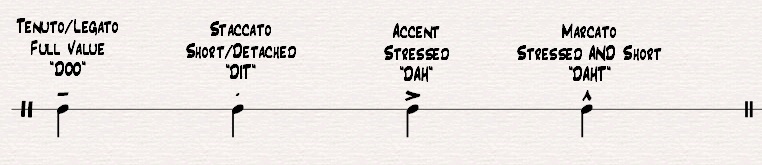
The use of jazz vocalizations can be helpful when trying to unify an ensemble’s sense of articulation. The articulation syllables below are used commonly in the jazz style.
Articulation Syllables:
|
